

The paper
Yphtach Lelkes, Ellie M. Mitchell, Erin Walk, and Sean J. Westwood (2026). Public responses to atrocities depend on partisanship and context, not legal labels. Proceedings of the National Academy of Sciences 123(30), e2608203123.
doi:10.1073/pnas.2608203123 (opens in a new tab) · Replication data: osf.io/9zg2d (opens in a new tab)
Main text
p. 1, introduction
Published
One study (8) found that calling a conflict genocide can actually decrease perceived collective responsibility—but their study used a hypothetical conflict and a single label [...]
Correction
One study (8) found that calling a conflict genocide can actually decrease support for intervention among Americans high in ingroup glorification, who down-regulate guilt and their perceived responsibility to intervene—but their study used a hypothetical conflict and a single label [...]
Basis Reference 8 (Leidner, 2015) concerns the responsibility of a bystander nation to intervene, as its title states. This paper’s collective-responsibility outcome is the responsibility of ordinary citizens of the perpetrator country for their government’s actions (SI Appendix, section 4).
p. 2, Results
Published
Across the full set of label contrasts, only one reaches conventional statistical significance: relative to the control wording, calling violence genocide slightly reduces attributions of collective responsibility (b = −0.17 SD, 95% CI [−0.30, −0.03]). This is the sole nominally significant result across 20 label–outcome tests; it does not survive Benjamini–Hochberg correction within the full test family (SI Appendix, section 10) and should be interpreted cautiously as a pattern consistent with chance rather than a reliable signal. This effect is also bounded: it does not generalize to the other legal labels (war crimes, crimes against humanity, ethnic cleansing), does not propagate to policy outcomes, and is not concentrated in a single conflict context.
Correction
Across the full set of label contrasts, none reaches conventional statistical significance. The largest, relative to the control wording, is for calling violence genocide, which slightly reduces attributions of collective responsibility (b = −0.17 SD, 95% CI [−0.37, 0.04]; P = 0.11), a pattern consistent with chance. This estimate is also bounded: it does not generalize to the other legal labels (war crimes, crimes against humanity, ethnic cleansing), does not propagate to policy outcomes, and is not concentrated in a single conflict context.
Basis SI Appendix, section 6 states that standard errors are HC2 heteroskedasticity-robust. The archived code (01_figure1.R) calls avg_slopes() without a vcov argument, so the published intervals use the classical variance of the weighted regression, which treats the survey weights as precision weights. For the 20 label contrasts, HC2 standard errors are 1.32 to 1.50 times the classical ones (the Kish design effect of the weights is 1.71). For genocide on collective responsibility the standard error rises from 0.071 to 0.104, and P from .020 to .11.
p. 2, Results
Published
Pooling across outcomes, the median absolute label coefficient is 0.04 SD, compared to 0.15 SD for country and 0.18 SD for partisanship.
Correction
Pooling across outcomes, the median absolute label coefficient is 0.05 SD, compared to 0.24 SD for country and 0.31 SD for partisanship.
Basis The archived code (01_figure1.R) adds rows with a coefficient of zero for the reference categories (Control, Democrat and China) before taking medians, so each party median equals the smaller of the two party contrasts and each country median includes a zero. The corrected values are medians over the estimated contrasts only, as SI Appendix, section 6 defines them (the median across outcomes of the per-outcome medians, as in the published calculation).
p. 2, Results
Published
Israel elicits lower support for punitive policies and lower moral attributions relative to the sample average. Sudan and Russia show the opposite: respondents express higher support for sanctions and boycotts and stronger moral attributions in those contexts.
Correction
Israel elicits lower support for punitive policies and lower sympathy for victims relative to the sample average, while ordinary Israelis are held more responsible for their government’s actions. Sudan and Russia show the opposite on policy and sympathy: respondents express higher support for sanctions and boycotts and more sympathy for victims in those contexts, and ordinary Russians are held the least responsible.
Basis Collective responsibility was analyzed on a reversed scale (see the correction to Fig. 1A). On the 1–5 scale of SI Appendix, section 4, weighted mean responsibility is 2.35 for Israel and 1.97 for Russia, against 2.19 for the full sample; mean sympathy is 3.01 for Israel and 3.69 for Russia, against 3.31.
p. 2, Results
Published
Sudan additionally elicits lower sympathy for its victims alongside higher punitive-policy support relative to China, a divergence consistent with racial empathy gaps documented in prior work (15).
Correction
Sudan additionally elicits higher sympathy for its victims alongside higher punitive-policy support relative to China.
Basis The sympathy outcome in Fig. 1A is coded so that higher values mean more sympathy. The Sudan − China coefficient is 0.28 SD (95% CI [0.03, 0.53], HC2), and the weighted Wave 2 means on the 1–5 scale are 3.46 for Darfuris and 3.21 for Uyghurs. The difference runs opposite to a racial empathy gap, so that interpretation and its citation are removed.
p. 2, Fig. 1A
Published
Fig. 1A, standardized coefficients with 95% confidence intervals. The panel titled “Ordinary Citizens Responsible” plots the reversed item (higher values = less responsibility), so the genocide estimate appears at +0.17.
Correction
Corrected Fig. 1A, with HC2 confidence intervals and collective responsibility on its natural scale (higher values = more responsibility).
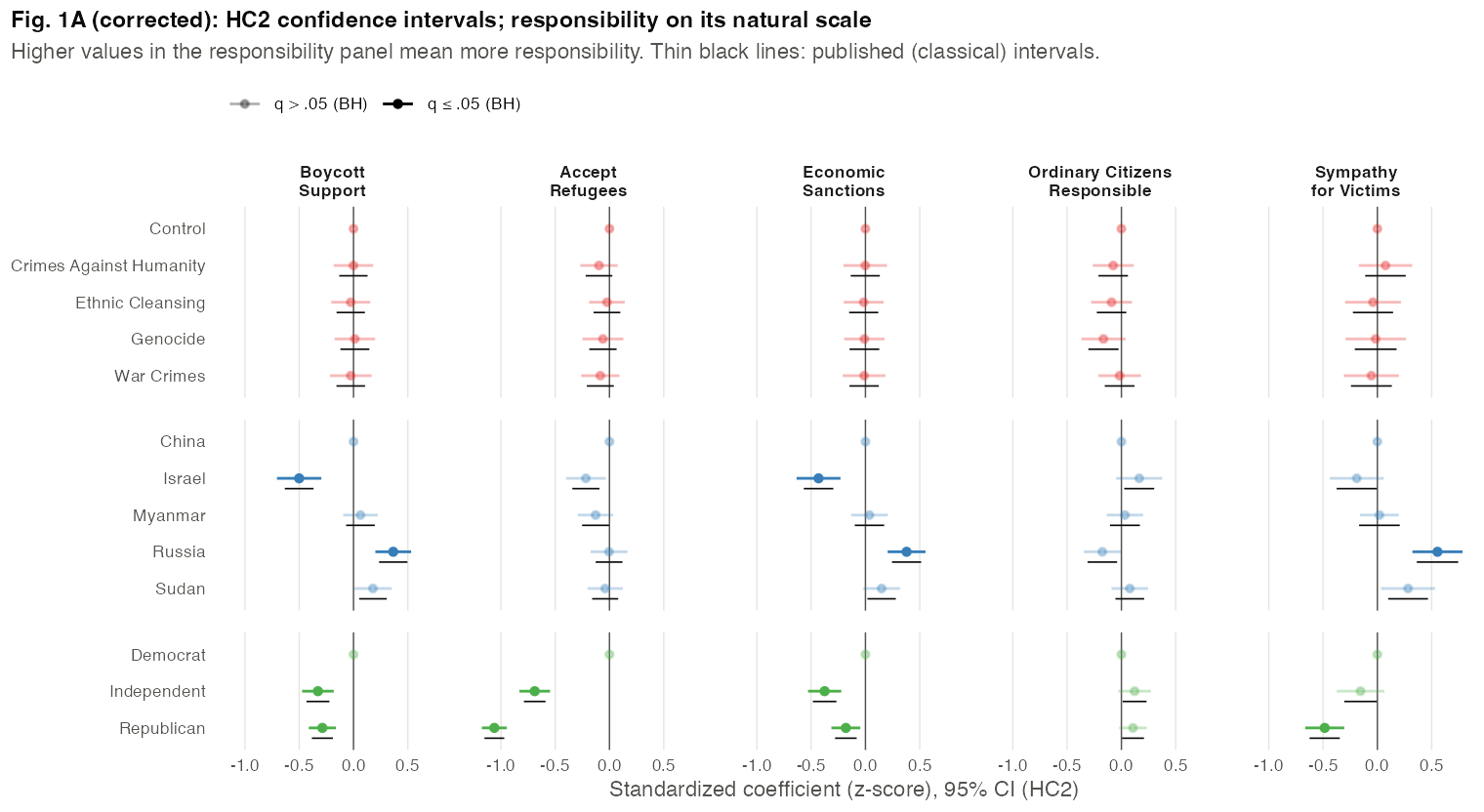
Basis On the natural scale the genocide estimate is −0.17, as the main text reports, and the country contrasts in that panel reverse: ordinary Israelis are held the most responsible (Israel − China 0.16) and ordinary Russians the least (Russia − China −0.18). Faded estimates are not significant after Benjamini–Hochberg correction within each predictor group, the rule of the published figure. Thin black lines show the published intervals. See the correction to p. 2, Results, on standard errors.
p. 2, Results
Published
holding wording fixed, the between-context spread ranges from 1.70 SD (control) to 2.21 SD (crimes against humanity).
Correction
holding wording fixed, the between-context spread ranges from 1.73 SD (control) to 2.16 SD (crimes against humanity).
Basis Values from the archived code (02_figure2.R) run on the public data.
Supplementary information
SI Appendix p. 2, section 2
Published
This yields approximately n ≈ 160 per cell pooled across waves.
Correction
This yields approximately n ≈ 80 per cell pooled across waves (range 63–96).
Basis Each wave has 1,000 respondents spread over 25 cells, about 40 per cell per wave (range 28–56). Cell counts are from the public data.
SI Appendix p. 2, section 2
Published
Formally testing condition × country interactions yields F-statistics that reach conventional significance for collective responsibility and sympathy but not for the three policy outcomes; [...] Of the 80 country × label tests, 12 are nominally significant at p < .05; after Benjamini–Hochberg correction, only two survive—both for collective responsibility in Russia (Genocide: b = 0.59 SD, q = .016; Crimes Against Humanity: b = 0.55 SD, q = .028)
Correction
Formally testing condition × country interactions yields F-statistics that reach conventional significance for collective responsibility, sympathy and sanctions (F = 1.70, p = .040) but not for boycotts or refugee admissions; [...] Of the 100 country × label tests, 12 are nominally significant at p < .05; after Benjamini–Hochberg correction, only two survive—both for collective responsibility in Russia (Genocide: b = −0.59 SD, q = .016; Crimes Against Humanity: b = −0.55 SD, q = .028)
Basis Computed with the archived code (06_label_by_country.R), which uses classical standard errors. It estimates 4 labels × 5 countries × 5 outcomes = 100 country-specific label effects, and the reported q-values are Benjamini–Hochberg adjustments over all 100. The two Russia estimates were fitted on the reversed responsibility item; they are shown here on its natural scale, where higher values mean more responsibility (see the correction to Fig. 1A).
SI Appendix p. 5, section 10, Deviations and extensions
Published
Deviations and extensions: [...] 6. IV/CACE analysis. The instrumental-variables model using recognition as endogenous and assignment as instrument was not preregistered. It is reported as a supplementary robustness check to address concerns that ITT effects may attenuate true label effects via non-recognition.
Correction
Deviations and extensions: [...] 6. IV/CACE analysis. The instrumental-variables model using recognition as endogenous and assignment as instrument was not preregistered. It is reported as a supplementary robustness check to address concerns that ITT effects may attenuate true label effects via non-recognition.
- Registration timing. Both registrations were filed after YouGov began fielding the corresponding wave and before we received that wave’s data. Wave 1 was fielded September 23–29, 2025, and Preregistration 1 was filed on September 30, 2025; its Question 8 records that the data had not yet been received. Wave 2 was fielded October 20–28, 2025, and Preregistration 2 was filed on October 21, 2025. Both registrations should have answered “It’s complicated” to AsPredicted’s data-collection question.
Basis AsPredicted #249,738 (Preregistration 1) is time-stamped 2025/09/30 20:00 (PT) and #253,187 (Preregistration 2) 2025/10/21 17:48 (PT); both answer Question 1 “No, no data have been collected for this study yet.” SI Appendix, section 1 gives the field dates. Preregistration 1’s Question 8 states: “The survey has been sent to YouGov for data collection, but we have not yet received the data.” Preregistration 2 has no such note. No reported result depends on the timing.
SI Appendix p. 5, section 11
Published
Main (pooled) ITT model (Equation 1; N = 2,000). MDEs by outcome: Sanctions d = 0.19; Boycotts d = 0.19; Refugee Admissions d = 0.18; Collective Responsibility d = 0.20; Sympathy d = 0.27.
Correction
Main (pooled) ITT model (Equation 1; N = 2,000). MDEs by outcome: Sanctions d = 0.27; Boycotts d = 0.26; Refugee Admissions d = 0.25; Collective Responsibility d = 0.28; Sympathy d = 0.37.
Basis MDE = 2.8 × the mean standard error of the four label contrasts, as defined in section 11, with the HC2 standard errors that section 6 states (see the correction to p. 2, Results).
SI Appendix p. 5, section 11
Published
For every label contrast except the one nominally significant result (genocide–collective responsibility, b = 0.17 SD), the 95% CI upper bound falls below the corresponding item MDE; that exception lies below its MDE of d = 0.20 and does not survive Benjamini–Hochberg correction. Label effects large enough to be both detectable and substantively meaningful are thus ruled out across all outcomes.
Correction
No label contrast is nominally significant; the largest, genocide–collective responsibility, is b = −0.17 SD (p = .11). The 95% confidence intervals bound the label effects to within ±0.21 to ±0.37 SD, depending on the outcome. Two one-sided tests establish equivalence within ±0.20 SD for 10 of the 20 label contrasts and within ±0.10 SD for 0 of 20. Label effects of 0.20 SD therefore cannot be ruled out for the other 10 label–outcome pairs.
Basis A confidence bound below the MDE is not a test of equivalence. Even with the classical standard errors of the published analysis, 5 of the 19 non-significant contrasts have a 95% confidence bound beyond ±MDE, and two one-sided tests establish equivalence within ±0.20 SD for 16 of 20. The equivalence tests use 90% confidence intervals with HC2 standard errors. On the natural responsibility scale the genocide estimate is negative (see the correction to Fig. 1A).
SI Appendix p. 5, section 11
Published
Country and party effects in the same main model range from d = 0.15 to d = 1.06 (median: d = 0.15 for country contrasts, d = 0.18 for party contrasts)—well above the label-contrast MDEs—ruling out a general inability to detect effects in this design.
Correction
Country and party effects in the same main model range in absolute value from d = 0.004 to d = 1.06 (median: d = 0.24 for country contrasts, d = 0.31 for party contrasts), ruling out a general inability to detect effects in this design.
Basis The smallest is the Russia − China contrast for refugee admissions. The medians exclude the zero rows for the reference categories (see the correction to p. 2, Results). With HC2 standard errors the label-contrast MDEs are 0.25 to 0.37 SD, so the medians are not well above them.
Supplementary Results (OSF) p. 8, Table S2, Collective Resp. rows
Published
Table S2, “Collective Resp.” rows, CACE [95% CI]: Genocide 0.46 [−0.17, 1.08]; War Crimes 0.05 [−1.07, 1.17]; Crimes Against Humanity 0.25 [−0.37, 0.86]; Ethnic Cleansing 0.40 [−0.43, 1.23]; Pooled 0.15 [−0.08, 0.38].
Correction
Corrected Collective Resp. rows of Table S2, with the item on its natural scale.
Corrected Table S2, Collective Responsibility rows: higher values mean more responsibility attributed to ordinary citizens. All other rows are unchanged. Label Outcome CACE SE 95% CI p Genocide Collective Resp. −0.46 0.32 [−1.08, 0.17] 0.152 War Crimes Collective Resp. −0.05 0.57 [−1.17, 1.07] 0.933 Crimes Against Humanity Collective Resp. −0.25 0.31 [−0.86, 0.37] 0.430 Ethnic Cleansing Collective Resp. −0.40 0.42 [−1.23, 0.43] 0.346 Pooled Collective Resp. −0.15 0.12 [−0.38, 0.08] 0.211 Basis The published rows were fitted on the reversed item (higher values = less responsibility), which the table does not state. See the correction to Fig. 1A.
Replication archive
AsPredicted #249,738 (aspredicted.org/nj2b-txrw) and #253,187 (aspredicted.org/in83w7), Question 1 (“Have any data been collected for this study already?”)
Published
No, no data have been collected for this study yet.
Correction
It's complicated. We have already collected some data but explain in Question 8 why readers may consider this a valid pre-registration nevertheless.
Basis YouGov had begun fielding each wave when its registration was filed (see the note added to SI Appendix, section 10). The registrations are linked in SI Appendix, section 10.