

The paper
Chelsey S. Clark, Elizabeth Levy Paluck, Sean J. Westwood, Maya Sen, Neil Malhotra, and Stephen Jessee (2023). Effects of a US Supreme Court ruling to restrict abortion rights. Nature Human Behaviour 8(1), 63–71.
doi:10.1038/s41562-023-01708-4 (opens in a new tab) · Replication data: doi:10.7910/DVN/C9SPVB (opens in a new tab)
Main text
p. 63, Abstract
Published
[...] show that the ruling directly influenced views about the constitutional legality of abortion and fetal viability.
Correction
[...] show that the ruling directly influenced views about the constitutional legality of abortion. The ruling’s estimated effect on perceived fetal viability is not robust to the pre-registered exclusion of respondents who were unaware of the ruling.
Basis Under the pre-registered exclusion, the change in perceived fetal viability after the ruling is −0.13 weeks (P = 0.73) in the panel and −0.01 weeks (P = 0.98) in the cross-section. Dropping only the interviews in which unaware respondents were shown a vignette summarizing the case leaves no significant estimate in either sample (P = 0.10 to 0.30). See the corrections to pp. 67 and 70 and Supplementary Tables 77 and 78.
p. 65, Summary of findings
Published
The leaked draft ruling was associated with a small increase in support of the more specific legal issue of overturning Roe v. Wade and of the holding in Dobbs v. Jackson Women’s Health Organization. [...] Additionally, the focus of Dobbs v. Jackson Women’s Health Organization on the constitutionality of abortion at 15 gestational weeks seems to have anchored public perception: after the ruling, we observed a shift among all respondents in perceived age of fetal viability from above 15 weeks on average to below 15 weeks on average.
Correction
The leaked draft ruling was associated with a small increase in support of the more specific legal issue of overturning Roe v. Wade and of the holding in Dobbs v. Jackson Women’s Health Organization. The increase for Dobbs v. Jackson Women’s Health Organization is not robust to the pre-registered exclusion of respondents unaware of the leak. [...] Additionally, the focus of Dobbs v. Jackson Women’s Health Organization on the constitutionality of abortion at 15 gestational weeks seems to have anchored public perception: after the ruling, we observed a shift among all respondents in perceived age of fetal viability from above 15 weeks on average to below 15 weeks on average. This shift is not robust to the pre-registered exclusion of respondents unaware of the ruling.
Basis See the corrections to pp. 66, 67 and 70.
p. 65, Norms: perceptions of Americans’ abortion opinions
Published
Respondents were significantly more likely to report that ‘people in America believe’ abortion should be legal for women who choose to have one (panel sample: 2.4 percentage points (pp); [...] cross-sectional sample: 2.0 pp; [...]) after the ruling compared to before (Fig. 1a–c).
Correction
Respondents’ ratings of how strongly ‘people in America believe’ abortion should be legal for women who choose to have one rose significantly (panel sample: 0.024 on a 0–1 scale; [...] cross-sectional sample: 0.020; [...]) after the ruling compared to before (Fig. 1a–c).
Basis The perceived-norm, personal-opinion, Court-legitimacy, Court-size and term-limit outcomes are five-point items rescaled to run from 0 to 1, so differences in them are points on that scale; the confidence intervals printed with them are already in those units. Percentage points would describe a change in the share of respondents. The corrections below apply the same units to these outcomes on pp. 65–67. The Roe v. Wade and Dobbs v. Jackson Women’s Health Organization items are binary, and their percentage points stand.
p. 65, size of the norm shift
Published
How large was the shift in norm perception after the Dobbs v. Jackson Women’s Health Organization ruling? We can compare it to the rate and size of change in personal attitudes towards abortion over the decade before Dobbs v. Jackson Women’s Health Organization. Since 2012, Americans’ personal attitudes favouring legalized abortion shifted on average 1 pp every year, with total support increasing 6 pp over the past decade^5^. The shift we observed in respondents’ norm perceptions of other Americans’ support for legalized abortion is equivalent to approximately one-third of the past decade’s total change in personal attitudes.
Correction
On a 0–1 scale, perceived American support for legal abortion rose by 0.024 in the panel and 0.020 in the cross-section after the Dobbs v. Jackson Women’s Health Organization ruling. Since 2012, Americans’ personal attitudes favouring legalized abortion shifted on average 1 pp every year, with total support increasing 6 pp over the past decade^5^. That change is in the percentage of Americans who favour legal abortion, a different metric from the norm scale, so the norm shift cannot be expressed as a fraction of it.
Basis The norm item is a five-point scale rescaled to run from 0 to 1 (see the preceding correction). The benchmark is a change in the percentage of Americans who say abortion should be legal.
p. 65, Court legitimacy
Published
For Republicans, Supreme Court legitimacy increased after the leak by 3.2 pp [...] in the panel (cross-sectional sample: 3.3 pp, [...]) and by an additional 4.6 pp [...] after the ruling (cross-sectional sample: 3.8 pp, [...]). However, for Democrats, Court legitimacy decreased by 6.5 pp [...] in the panel (cross-sectional sample: 7.9 pp; [...]) after the leak and by an additional 4.8 pp [...] after the final ruling (cross-sectional sample: 3.5 pp, [...]). From baseline to after the ruling, perceived legitimacy decreased substantially among Democrats (11.3 pp in the panel and 11.4 pp in the cross-sectional sample).
Correction
For Republicans, Supreme Court legitimacy increased after the leak by 0.032 on the 0–1 legitimacy scale [...] in the panel (cross-sectional sample: 0.033, [...]) and by an additional 0.046 [...] after the ruling (cross-sectional sample: 0.038, [...]). However, for Democrats, Court legitimacy decreased by 0.065 [...] in the panel (cross-sectional sample: 0.079; [...]) after the leak and by an additional 0.048 [...] after the final ruling (cross-sectional sample: 0.035, [...]). From baseline to after the ruling, perceived legitimacy decreased substantially among Democrats (0.113 in the panel and 0.113 in the cross-sectional sample).
Basis The legitimacy index averages five items, each rescaled to run from 0 to 1 (see the correction to the norm results above). The Democratic totals are the sums of the unrounded leak and ruling estimates; the printed 11.4 adds the rounded 7.9 and 3.5.
pp. 65–66, Court size and term limits
Published
[...] in the panel sample (4.9 pp; [...]) and in the cross-sectional sample (7.6 pp; [...]). There was an additional differential effect of the ruling in the panel sample (4.3 pp; [...]) but not in the cross-sectional sample (−1.6 pp; t(12,159) = −0.87, P = 0.38, 95% CI = −0.02 to 0.053). Compared to Republicans, Democrats were also more supportive by 7.8 pp [...] in the panel sample and 9.9 pp [...] in the cross-sectional sample) of establishing term limits after the leak. After the ruling, Democrats were an additional 7.9 pp [...] in the panel sample, and 6.1 pp [...] in the cross-sectional sample) more supportive of the proposed policy.
Correction
[...] in the panel sample (0.049 on a 0–1 scale; [...]) and in the cross-sectional sample (0.076; [...]). There was an additional differential effect of the ruling in the panel sample (0.043; [...]) but not in the cross-sectional sample (−0.016; t(12,159) = −0.87, P = 0.38, 95% CI = −0.053 to 0.020). Compared to Republicans, Democrats were also more supportive by 0.078 [...] in the panel sample and 0.099 [...] in the cross-sectional sample) of establishing term limits after the leak. After the ruling, Democrats were an additional 0.079 [...] in the panel sample, and 0.061 [...] in the cross-sectional sample) more supportive of the proposed policy.
Basis Support for enlarging the Court and for term limits are five-point items rescaled to run from 0 to 1. The estimates are the Democrat-minus-Republican difference in the change, the convention of the printed estimates and t statistics. The printed interval for the cross-sectional ruling interaction, −0.02 to 0.053, is the interval for the coefficient with the opposite sign. Its significance is unchanged.
p. 66, personal attitudes
Published
In the cross-section analysis only, we found a statistically significant 2.6 pp increase in personal support for maintaining legal abortion access [...] associated with the ruling.
Correction
In the cross-section analysis only, we found a statistically significant increase of 0.026 on a 0–1 scale in personal support for maintaining legal abortion access [...] associated with the ruling.
Basis Personal support is a five-point item rescaled to run from 0 to 1 (see the correction to p. 65).
p. 66, views of Dobbs v. Jackson Women’s Health Organization after the leak
Published
Also after the leak, we found a 3.3 pp increase in support of upholding the constitutionality of the Mississippi abortion restriction at issue in Dobbs v. Jackson Women’s Health Organization [...], although the effect was statistically significant in the cross-sectional sample only.
Correction
[...], although the effect was statistically significant in the cross-sectional sample only. The cross-sectional estimate is not robust to the pre-registered exclusion of respondents unaware of the leak (0.9 pp, P = 0.55; Supplementary Table 77).
Basis Dropping only the interviews in which unaware respondents were shown a vignette summarizing the case gives P = 0.054 with the remaining unaware respondents reweighted and P = 0.15 without reweighting (Supplementary Table 78). See the correction to p. 70.
p. 67, fetal viability
Published
In both samples, we found that perceptions of the average age of viability decreased significantly after the Court ruling, from just above 15 weeks to just below 15 weeks: [...] There was a non-significant downward trend for Republicans and a statistically significant downward trend among Democrats in the cross-section and among Republicans in the panel.
Correction
In both samples, we found that perceptions of the average age of viability decreased significantly after the Court ruling, from just above 15 weeks to just below 15 weeks: [...] These estimates are not robust to the pre-registered exclusion of respondents unaware of the ruling (panel: −0.13 weeks, P = 0.73; cross-section: −0.01 weeks, P = 0.98; Supplementary Table 77). In the cross-section, there was a non-significant downward trend for Republicans (−0.87 weeks, P = 0.102) and a statistically significant downward trend among Democrats (−1.88 weeks, P < 0.001). In the panel, the downward trends among Republicans (−1.07 weeks, P = 0.075) and Democrats (−0.86 weeks, P = 0.244) were not statistically significant.
Basis Supplementary Table 47 reports the panel estimate for Republicans as −1.073 weeks, 95% CI −2.255 to 0.109, P = 0.075. Dropping only the interviews in which unaware respondents were shown a vignette summarizing the case leaves no significant fetal-viability estimate in either sample (P = 0.10 to 0.30; Supplementary Table 78). See the correction to p. 70.
p. 67, Attention to social media commentary on the Court
Published
Figure 5a shows that people paid attention to the issue on Twitter after the leak and Fig. 5c shows that immediately after the ruling, 4 million tweets engaged with abortion polls showing that the majority of Americans supported legalized abortion. For scale, a recent national event, the 6 January 2021 attack on the US Capitol, generated approximately 10 million tweets^26^.
Correction
Figure 5a shows that people paid attention to the issue on Twitter after the leak and Fig. 5c shows that immediately after the ruling, 4,344 tweets on 27 June 2022 engaged with abortion polls showing that the majority of Americans supported legalized abortion.
Basis The printed 4 million is that day’s summed engagement with these tweets (3,993,679 likes, quotes, replies and retweets, plus one per tweet), and 3,738 of the 4,344 tweet records are retweets that carry the original tweet’s retweet count (see the correction to Fig. 5a). The comparison with about 10 million tweets on the 6 January 2021 attack (ref. 26) set this engagement total against a count of tweets and is removed.
p. 67, sentiment of tweets
Published
Figure 5b,d show that the sentiment of the majority of tweets about abortion and about polling were negative, allowing any individual observing these tweets to infer widespread displeasure with the Court for rolling back the constitutional protection of abortion access.
Correction
Figure 5b,d show the shares of tweets about abortion and about polling that a sentiment lexicon classified as negative and positive (Supplementary Information, Section 7).
Basis The plotted shares (72% and 64% negative) come from two summary files in the replication archive, abortion_tweets.csv and sentiment_polls.csv. No archived code produces them and the archive holds no tweet text or IDs, so they cannot be reproduced. The archived tweet records carry their own sentiment labels, which classify 37% of non-neutral abortion tweets and 21% of non-neutral polling tweets as negative. The public materials therefore establish neither that most tweets were negative nor the inference about displeasure with the Court.
p. 67, source of leak knowledge
Published
Complementing this analysis, we found in our survey data that learning about the leak from social media (approximately 38% of our sample) was associated with [...]
Correction
Complementing this analysis, we found in our survey data that, among respondents aware of the leak, learning about it from social media (approximately 38% of those respondents and 25% of the wave 2 cross-section) was associated with [...]
Basis The question on sources of information was asked only of respondents who identified the leak (3,568 of the 5,000 wave 2 cross-section respondents), and the regressions that follow use those respondents. Shares are weighted.
p. 67, social media and personal attitudes
Published
[...] was positively related to social media exposure (11 pp) [...]
Correction
[...] was positively related to social media exposure (0.11 on a 0–1 scale) [...]
Basis Personal support is a five-point item rescaled to run from 0 to 1 (see the correction to p. 65).
p. 68, Fig. 5a
Published
Fig. 5a, ‘Engagement with tweets about abortion’, with labels ‘Maximum engagements 114,001,752’ (leak) and ‘Maximum engagements 78,243,076,311’ (ruling).
Correction
Corrected Fig. 5a, with retweet records excluded. Maximum daily engagement is 232,248 (2 May) around the leak and 39,223,916 (24 June) around the ruling.
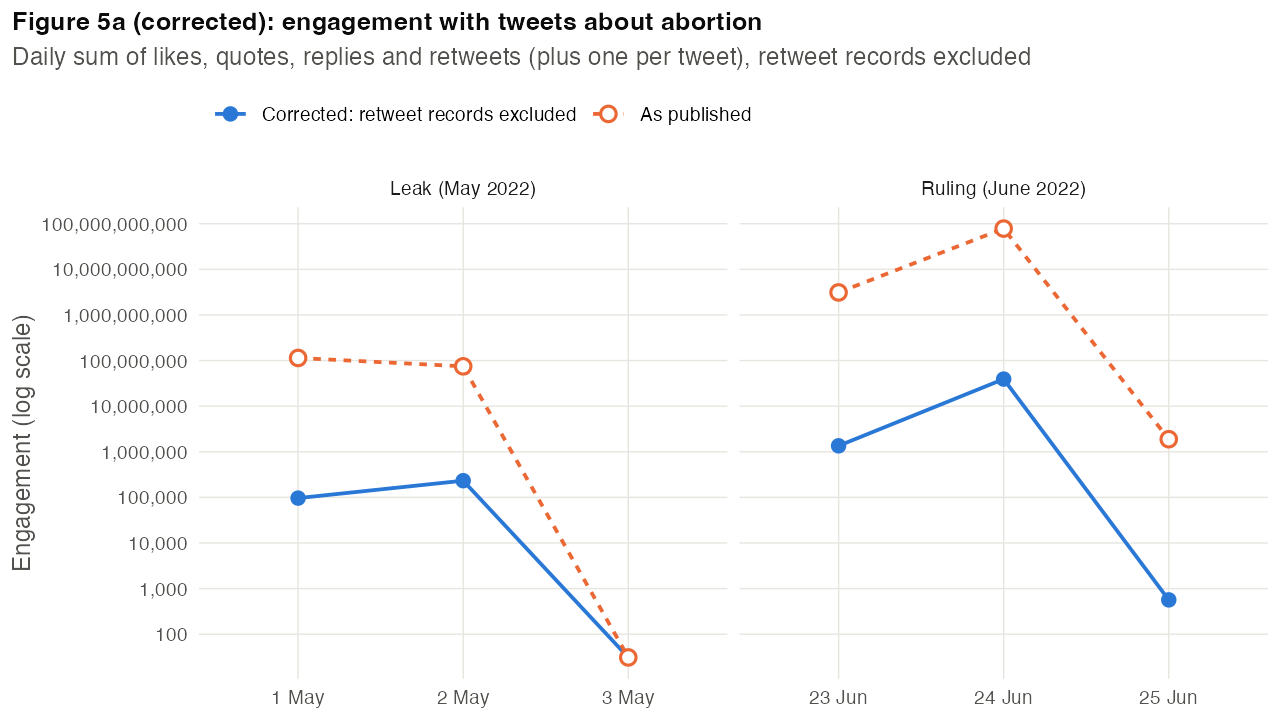
Basis Fig. 5a sums each tweet record’s likes, quotes, replies and retweets, plus one, by day. In the archived files, 81% of June records and 73% of May records have no likes, quotes or replies and a positive retweet count, and they supply 99.95% and 99.8% of each file’s total. These records are retweets, which the Twitter API returns with the original tweet’s retweet count. One retweet count, 74,900, appears on 40,499 of them, and together they add 3.03 billion. Summing the records therefore adds each original tweet’s retweet count once for every retweet. The dashed line shows the published values (maxima 114,001,752 and 78,243,076,311); the y axis is logarithmic.
p. 68, Fig. 5b
Published
Fig. 5b, y axis: ‘Proportion of poll tweets’
Correction
Fig. 5b, y axis: ‘Proportion of abortion tweets’
Basis Panel b shows tweets about abortion; its axis label repeats that of panel d. The shares in panels b and d cannot be reproduced from the public archive (see the correction to p. 67).
p. 68, Fig. 5c
Published
Fig. 5c, ‘Number of tweets about abortion polling’ (y axis ‘Tweets’, 0 to 4,000,000).
Correction
Corrected Fig. 5c, counting tweets. The peak is 4,344 tweets on 27 June 2022.
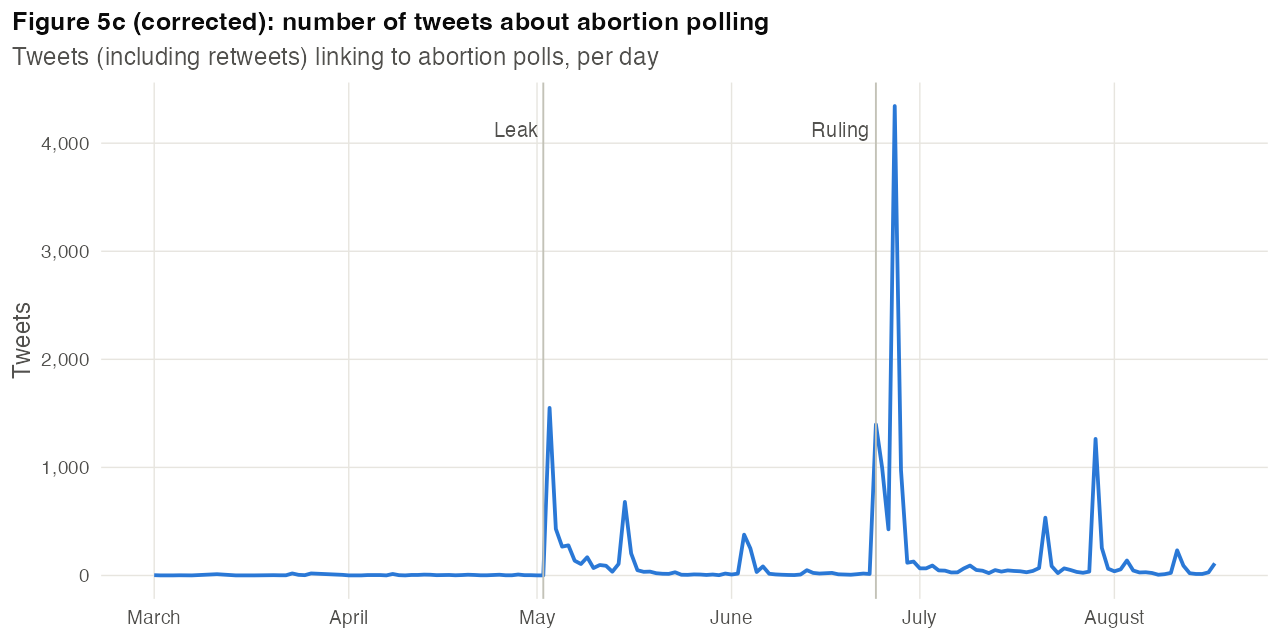
Basis The published panel plots the daily sum of engagement (likes, quotes, replies and retweets, plus one per tweet) under the label ‘Tweets’; its peak of 3,993,679 on 27 June 2022 is the engagement with 4,344 tweets. The corrected panel counts each tweet record, including retweets, once.
p. 69, Discussion
Published
For example, it is likely that the framing of Dobbs v. Jackson Women’s Health Organization anchored the public on the 15-week gestational window as a critical time for ending pregnancies.
Correction
For example, the framing of Dobbs v. Jackson Women’s Health Organization may have anchored the public on the 15-week gestational window as a critical time for ending pregnancies, although the fetal-viability estimates are not robust to the pre-registered exclusion of respondents unaware of the ruling (see the correction to p. 67).
p. 70, Methods, Analytic strategy
Published
We pre-registered our survey and analysis plan immediately after the leak and before the initial recontact of the panel and the new cross-sectional survey at wave 2.
Correction
We registered our survey and analysis plan on 31 May 2022, after wave 2 fieldwork (13–23 May 2022) had ended and before any author had opened the wave 2 data.
Basis The registration (doi:10.17605/OSF.IO/DS6KB) is dated 31 May 2022. It states that its file date falls after wave 2 data collection ended and that none of the authors had opened or looked at the data, and Supplementary Information section 10.2 repeats this. The Methods sentence placed registration before wave 2 fieldwork began on 13 May (p. 69).
p. 70, Methods, Analytic strategy (deviations from the pre-registration)
Published
We note three deviations from our pre-registered plan: (1) [...]; (2) [...]; (3) we did not collect an additional three waves of data because of funding shortage.
Correction
We note four deviations from our pre-registered plan: (1) [...]; (2) [...]; (3) we did not collect an additional three waves of data because of funding shortage; (4) our pre-registration stated that respondents unaware of the leak (wave 2) or of the ruling (wave 3) would be omitted from both the panel and the cross-sectional analyses. We did not apply this exclusion, and the original article did not report the deviation. All estimates in the article include unaware respondents. Supplementary Information section 11 explains why we treat the full-sample estimates as primary and reports estimates under the pre-registered exclusion.
Basis Under the pre-registered exclusion (Supplementary Table 77), the estimates for perceived norms (P = 0.12 in the panel and 0.12 in the cross-section), fetal viability (P = 0.73 and 0.98) and the cross-sectional effect of the leak on support for upholding the Mississippi law (P = 0.55) are smaller and not statistically significant. The cross-sectional effect of the leak on support for overturning Roe v. Wade remains significant (P = 0.03).
Supplementary information
SI section 2.3, p. 5, Note on deviation from our pre-analysis plan
Published
We pre-registered a third model that would control for the day-of-interview. [...] The interviews were so closely clustered with the major events (leak/decision) that the results accounting for the day of interview were unstable and not informative.
Correction
[...] The interviews were so closely clustered with the major events (leak/decision) that the results accounting for the day of interview were unstable and not informative. We also did not apply the pre-registered exclusion of respondents who were unaware of the leak or the ruling; Section 11 describes this deviation and reports estimates under the exclusion.
SI, new section 11 (after section 10), with Supplementary Tables 77 and 78
Correction
11. Respondents unaware of the leak or the ruling
The pre-registration (OSF DS6KB; Section 10) commits to omitting respondents who were unaware of the leak at wave 2 or of the ruling at wave 3, in both the panel and the cross-section. Awareness was measured with a multiple-choice item. At wave 2 it asked on which issue a Supreme Court leak had recently occurred. At wave 3 it asked on which issue the Court had recently issued an opinion. Respondents who chose abortion were coded as aware. Our analyses retained unaware respondents, and the original article did not report this deviation. We treat the full-sample estimates as primary for two reasons.
First, the full sample estimates the quantity that the pre-registration identifies as the one this design can recover. The pre-registration states (Section 10.6): “Like all exposure-based time series designs we can only estimate intent to treat (ITT) effects as exposure to major events will be conditional on the individual respondent’s interest in politics, social network, etc. This risks decreasing power in our analysis. We deal with this by asking respondents if they were aware of the case in question.” The exclusion was introduced to increase power. Our estimand is the change in public opinion after the leak and the ruling, and that change includes the opinions of people who did not follow the news. The full-sample models estimate this intent-to-treat effect.
Second, the exclusion conditions on a variable that the leak and the ruling themselves created. Awareness of an event can exist only after the event. Who becomes aware also depends on interest in politics and media use, which are related to the outcomes. In the cross-section, 67.1% of respondents (weighted) correctly identified the leak at wave 2, and 82.3% correctly identified the ruling at wave 3. In the panel the figures are 72.0% and 85.1%. Wave 1 was fielded before the leak and has no awareness item, so the exclusion applies only to waves 2 and 3. The pre-registered estimates therefore compare all wave 1 respondents with the aware subset at wave 2, and that subset with a larger aware subset at wave 3. Each wave draws on a different population. The resulting differences combine any change in opinion with the change in who was aware. Conditioning on a post-treatment variable in this way can bias estimates in either direction (Montgomery, Nyhan and Torres 2018).
The full sample also includes unaware respondents whom the survey randomly assigned (50/50) to read a short vignette summarizing the case and the leak or the ruling before the outcome questions (Section 10.6; 1,149 cross-sectional and 301 panel interviews). Among unaware cross-sectional respondents, the vignette had no detectable effect on perceived norms, perceived fetal viability, or views of Roe v. Wade or Dobbs v. Jackson Women’s Health Organization (P = 0.58 to 0.90; weighted OLS with wave fixed effects).
Supplementary Table 77 reports the estimates under the pre-registered exclusion next to the full-sample estimates. Under the exclusion, the estimates for perceived norms, fetal viability and the cross-sectional effect of the leak on views of Dobbs v. Jackson Women’s Health Organization are smaller and not statistically significant. The cross-sectional effect of the leak on views of Roe v. Wade remains significant. Supplementary Table 78 drops only the interviews in which the vignette was shown. Half of the unaware respondents were assigned to the vignette at random, so the table reports these estimates with the remaining unaware respondents’ weights doubled, which keeps unaware respondents at their share of the sample, and without reweighting. In both versions the cross-sectional norm shift and the cross-sectional effect of the leak on views of Roe v. Wade remain significant, and the fetal-viability estimates are not statistically significant in either sample (P = 0.10 to 0.30). The cross-sectional effect of the leak on views of Dobbs v. Jackson Women’s Health Organization has P = 0.054 with reweighting and P = 0.15 without. The fetal-viability and Dobbs v. Jackson Women’s Health Organization results are therefore not robust to the pre-registered exclusion.
Montgomery, J. M., Nyhan, B. & Torres, M. How conditioning on posttreatment variables can ruin your experiment and what to do about it. Am. J. Polit. Sci. 62, 760–775 (2018).
Supplementary Table 77: Estimates with all respondents and under the pre-registered exclusion of respondents unaware of the leak (wave 2) or the ruling (wave 3). Coefficient [95% CI], p. Perceived support is on a 0–1 scale, the Dobbs and Roe items are binary (0–1), and fetal viability is in weeks. Models as in Supplementary Tables 2, 3, 16 and 17. Outcome Sample All respondents (published) N (all) Aware respondents only (pre-registered) N (aware only) Perceived American support for legal abortion, ruling Panel 0.024 [0.007, 0.041], p = 0.007 3,345 0.016 [−0.004, 0.035], p = 0.121 2,756 Perceived American support for legal abortion, ruling Cross-section 0.020 [0.007, 0.033], p = 0.003 10,047 0.012 [−0.003, 0.027], p = 0.124 7,816 Perceived age of fetal viability (weeks), ruling Panel −1.04 [−1.71, −0.36], p = 0.003 2,418 −0.13 [−0.87, 0.61], p = 0.732 2,019 Perceived age of fetal viability (weeks), ruling Cross-section −0.66 [−1.32, −0.01], p = 0.048 7,281 −0.01 [−0.74, 0.72], p = 0.975 5,784 Support for upholding the Mississippi law (Dobbs), leak Panel 0.016 [−0.012, 0.045], p = 0.262 5,429 0.018 [−0.011, 0.047], p = 0.220 4,855 Support for upholding the Mississippi law (Dobbs), leak Cross-section 0.033 [0.005, 0.062], p = 0.023 12,007 0.009 [−0.021, 0.040], p = 0.554 9,841 Roe v. Wade should be overturned, leak Panel 0.030 [0.005, 0.055], p = 0.020 5,449 0.019 [−0.005, 0.043], p = 0.118 4,875 Roe v. Wade should be overturned, leak Cross-section 0.064 [0.036, 0.091], p < 0.001 12,098 0.033 [0.003, 0.062], p = 0.029 9,918 Supplementary Table 78: Estimates without the interviews in which unaware respondents were shown the vignette summarizing the case. Reweighted: the remaining unaware respondents' weights are doubled, since half of all unaware respondents were assigned to the vignette at random. Coefficient [95% CI], p. Units as in Supplementary Table 77. Outcome Sample All respondents (published) N (all) Without vignette interviews, unaware reweighted Without vignette interviews, not reweighted N (without vignette interviews) Perceived American support for legal abortion, ruling Panel 0.024 [0.007, 0.041], p = 0.007 3,345 0.019 [−0.001, 0.040], p = 0.062 0.019 [0.000, 0.038], p = 0.049 3,048 Perceived American support for legal abortion, ruling Cross-section 0.020 [0.007, 0.033], p = 0.003 10,047 0.021 [0.007, 0.036], p = 0.004 0.018 [0.004, 0.032], p = 0.012 8,911 Perceived age of fetal viability (weeks), ruling Panel −1.04 [−1.71, −0.36], p = 0.003 2,418 −0.65 [−1.40, 0.11], p = 0.096 −0.49 [−1.20, 0.22], p = 0.176 2,219 Perceived age of fetal viability (weeks), ruling Cross-section −0.66 [−1.32, −0.01], p = 0.048 7,281 −0.56 [−1.31, 0.19], p = 0.141 −0.37 [−1.06, 0.33], p = 0.299 6,535 Support for upholding the Mississippi law (Dobbs), leak Panel 0.016 [−0.012, 0.045], p = 0.262 5,429 0.009 [−0.022, 0.040], p = 0.562 0.011 [−0.018, 0.040], p = 0.451 5,138 Support for upholding the Mississippi law (Dobbs), leak Cross-section 0.033 [0.005, 0.062], p = 0.023 12,007 0.030 [−0.001, 0.060], p = 0.054 0.021 [−0.008, 0.051], p = 0.153 10,908 Roe v. Wade should be overturned, leak Panel 0.030 [0.005, 0.055], p = 0.020 5,449 0.018 [−0.009, 0.044], p = 0.191 0.018 [−0.006, 0.043], p = 0.142 5,156 Roe v. Wade should be overturned, leak Cross-section 0.064 [0.036, 0.091], p < 0.001 12,098 0.063 [0.033, 0.093], p < 0.001 0.051 [0.022, 0.079], p < 0.001 10,987 Basis Estimates use the authors’ archived cleaning code and models; only the samples change. Under the exclusion, the post-leak interviews of unaware respondents are dropped.