

Policy criticism
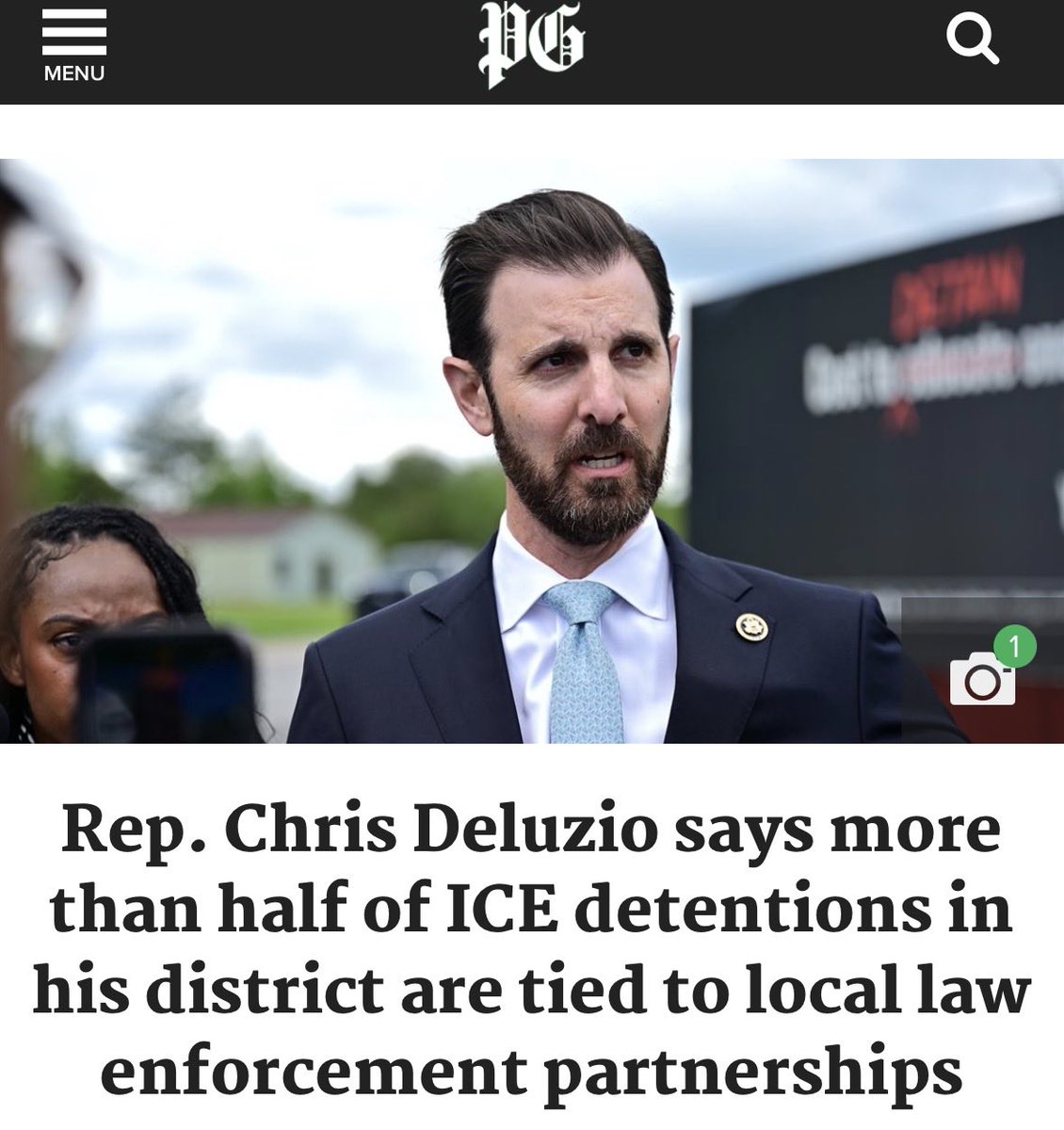
The text of this post is on X; follow the source link to read it.
Nov 16, 2026 · Posts on X · policy criticism; policy discussion; Crime and Law Enforcement; Immigration · Source
37% of individual money in the 2026 cycle came in gifts of $200 or less; the median for House Democrats is 13%. Ranks 23rd of 214, where 1st is the highest share. $3.8M raised in all.
Campaigns report every donor who gives more than $200 by name and smaller gifts only as one total; this is that small-gift total as a share of all money from individuals, from the FEC’s committee summaries, ranked among House Democrats. It understates small giving when a campaign itemizes gifts made through ActBlue or WinRed.
6 measures against House Democrats. 0.6% of Deluzio’s statements use an extreme label, in the bottom quarter of House Democrats (average 1.9%). Deluzio raised $3.8M in the 2026 cycle, in the top quarter of House Democrats (median $2.0M).
The measures on which Deluzio sits furthest from the middle of House Democrats, each against the same group, with the CSIP score when there is one. Every number is explained in its own section below.
Attendance
House Democrats average 96.9% · ranks 10th of 217 · 687 roll calls
Small donations, 2026
House Democrats’ median 13% · ranks 23rd of 214
Extreme labels
House Democrats average 1.9% · ranks 172nd of 216
Raised, 2026
House Democrats’ median $2.0M · ranks 50th of 214
Policy criticism
House Democrats average 27% · ranks 69th of 216
CSIP ideology
Left of 0, the centre of the scale · ± 0.02
Peer group: House Democrats. Rank 1 is the highest value in the group; the thick bar is Deluzio, the thin grey bar the peer average. The headline is the measure on which Deluzio is most unusual among peers (Methods, §08).
Congressional District 17 (119th Congress): the district as drawn for 2024
754,615 people (±1,108)
District
United States
Pennsylvania
| Group | District | Pennsylvania | U.S. |
|---|---|---|---|
| White | 83 | 73 | 57 |
| Black | 7 | 10 | 12 |
| Hispanic or Latino | 3 | 9 | 19 |
| Asian | 3 | 4 | 6 |
| Another race or more than one | 5 | 4 | 5 |
Hispanic or Latino people may be of any race; the other groups are not Hispanic.
Where it falls among the House districts: the centre rule is the median, the edges the lowest and the highest
| Measure | Here | ± | The typical House district | Percentile | Standing |
|---|---|---|---|---|---|
| Median household income | $85,900 | ±$1,405 | $78,700 | 62 | near the middle of the House districts |
| Below the poverty line | 8.1% | ±0.4 | 12% | 13 | fewer than in 3 of every 4 House districts |
| Bachelor’s degree or more | 45% | ±0.6 | 33% | 81 | more than in 3 of every 4 House districts |
| Median age | 43.2 | ±0.3 | 39.1 | 92 | higher than in 9 of every 10 House districts |
| Aged 65 and over | 22% | ±0.3 | 17% | 92 | more than in 9 of every 10 House districts |
| Born outside the U.S. | 5.1% | ±0.3 | 10% | 20 | fewer than in 3 of every 4 House districts |
| Veterans | 6.3% | ±0.3 | 6.3% | 51 | near the middle of the House districts |
| Living in rural areas | 9.4% | — | 15% | 41 | near the middle of the House districts |
Source: ACS 2020–2024 5-year estimates (Census Bureau); rural share from the 2020 Census.
The figures from the American Community Survey are estimates from a sample, not a count. The ± beside each is its 90 percent margin of error: nine times in ten the true value lies within that range. In small districts the margins are wide, so a gap of a few points from Pennsylvania may be noise. Shares are of everyone in the district, except education (adults 25 and over), poverty (people whose poverty status is known) and veterans (civilian adults).
These are the Census Bureau’s own estimates for the district; margins on shares are approximated from the counts’ margins.
The rural share counts the people living outside the urban areas the Census Bureau drew from the 2020 Census; it is a count, with no margin of error.
Deluzio attacks opponents personally less than 65% of House Democrats. Personal attacks in 3.8% of 1,793 statements, against 6.5% for the average House Democrat; 142nd of 216.
An AI model reads each of Deluzio’s 1,793 statements in the 119th Congress (1,433 posts on X, 266 press releases, 59 newsletters, 35 Congressional Record speeches) and marks the kinds of statement it contains: a personal attack, criticism of a policy, discussion of policy, bipartisanship, credit claiming, and extreme labels. A statement can carry several. Every rate is compared with the average for House Democrats and ranked among them.
Share of statements carrying each label, the 119th Congress
| Row | Deluzio | Peers |
|---|---|---|
| Policy discussion | 75% | 73% |
| Policy criticism | 32% | 27% |
| Credit claiming | 25% | 23% |
| Bipartisanship | 10% | 10% |
| Personal attacks | 4% | 7% |
statements classified
1,433 posts on X, 266 press releases, 59 newsletters, 35 Congressional Record speeches.
| Part | Value |
|---|---|
| posts on X | 1,433 |
| press releases | 266 |
| newsletters | 59 |
| Congressional Record speeches | 35 |
The thick bar is Deluzio, in the colour of that kind of statement; the thin grey bar is the average House Democrats. A longer thick bar means Deluzio does this more than peers. Rank 1 is the highest rate in the group.
Deluzio used extreme labels in 0.6% of statements, 30% of the peer average. 10 statements, most often aimed at Arizona Republican; peers 1.9%.
Targets named alongside an extreme label, by number of statements
Calls a politician, a party or a policy “far left”, “far right”, “MAGA”, “extreme”, “radical”, “woke”, “fascist” or “communist”. The target is who or what the label was aimed at. The lists show the five most used labels and targets; the toggle shows the rest.
Share of statements per month, the 119th Congress
| Column | Statements | Personal attacks | Policy criticism | Policy discussion | Bipartisanship | Credit claiming | Extreme labels |
|---|---|---|---|---|---|---|---|
| Jan ’25 | 92 | 2.2% | 28.3% | 67.4% | 17.4% | 37.0% | 1.1% |
| Feb ’25 | 70 | 4.3% | 42.9% | 72.9% | 17.1% | 37.1% | 2.9% |
| Mar ’25 | 82 | 6.1% | 42.7% | 75.6% | 18.3% | 19.5% | 1.2% |
| Apr ’25 | 66 | 3.0% | 47.0% | 77.3% | 3.0% | 21.2% | 1.5% |
| May ’25 | 69 | 5.8% | 47.8% | 75.4% | 13.0% | 17.4% | 0.0% |
| Jun ’25 | 68 | 2.9% | 29.4% | 63.2% | 11.8% | 30.9% | 0.0% |
| Jul ’25 | 77 | 3.9% | 42.9% | 80.5% | 14.3% | 36.4% | 0.0% |
| Aug ’25 | 72 | 4.2% | 44.4% | 77.8% | 8.3% | 26.4% | 0.0% |
| Sep ’25 | 89 | 1.1% | 37.1% | 77.5% | 14.6% | 39.3% | 2.3% |
| Oct ’25 | 83 | 3.6% | 54.2% | 81.9% | 16.9% | 16.9% | 1.2% |
| Nov ’25 | 78 | 5.1% | 23.1% | 51.3% | 15.4% | 21.8% | 0.0% |
| Dec ’25 | 89 | 4.5% | 22.5% | 84.3% | 22.5% | 30.3% | 0.0% |
| Jan ’26 | 103 | 2.9% | 23.3% | 90.3% | 11.7% | 30.1% | 0.0% |
| Feb ’26 | 72 | 2.8% | 25.0% | 63.9% | 5.6% | 22.2% | 0.0% |
| Mar ’26 | 90 | 2.2% | 43.3% | 68.9% | 4.4% | 16.7% | 0.0% |
| Apr ’26 | 96 | 1.0% | 24.0% | 64.6% | 2.1% | 11.5% | 1.0% |
| May ’26 | 112 | 2.7% | 26.8% | 76.8% | 7.1% | 27.7% | 0.0% |
| Jun ’26 | 84 | 4.8% | 41.7% | 63.1% | 5.9% | 20.2% | 1.2% |
| Jul ’26 | 84 | 4.8% | 25.0% | 79.8% | 5.9% | 19.1% | 0.0% |
| Aug ’26 | 71 | 8.5% | 12.7% | 84.5% | 5.6% | 26.8% | 0.0% |
| Sep ’26 | 53 | 11.3% | 17.0% | 83.0% | 5.7% | 26.4% | 0.0% |
| Oct ’26 | 53 | 0.0% | 5.7% | 81.1% | 1.9% | 20.8% | 0.0% |
| Nov ’26 | 40 | 2.5% | 10.0% | 82.5% | 5.0% | 12.5% | 0.0% |
Each row is one kind of statement; each cell is a month, shaded against that row’s own peak (darker = closer to the peak), with the peak and the latest value written at the right. The top row counts statements. The strip covers every month of the 119th Congress, the same span as the rates above, including months with no statements. A month with fewer than 10 statements is hatched, not shaded: one or two posts would swing its rate to 0% or 100%.
Real statements from the classifier’s example set, with the labels it assigned
Policy criticism
The text of this post is on X; follow the source link to read it.
Nov 16, 2026 · Posts on X · policy criticism; policy discussion; Crime and Law Enforcement; Immigration · Source
Personal attacks
The text of this post is on X; follow the source link to read it.
Nov 19, 2026 · Posts on X · personal attacks; target: Donald Trump · Source
Extreme label
The text of this post is on X; follow the source link to read it.
Jun 27, 2026 · Posts on X · policy criticism; policy discussion; Civil Rights and Liberties, Minority Issues; extreme label “extreme” aimed at right-wing politicians · Source
Up to five recent statements in each category
Overtly questions a named person’s character, integrity or loyalty, or calls them names. Criticising a record or a policy does not count.
Posts on X
The text of this post is on X; follow the source link to read it.
personal attacks · target: Donald TrumpSource
Press releases
Deluzio Joins Push to Stop Trump from Hiding True Cost of Iran War, Dishonoring Fallen Servicemembers WASHINGTON, D.C. — Today, Iraq War veteran and House Armed Services Committee member Congressman Chris Deluzio (PA-17) helped announce the new Honoring the Sacrifices of Our Troops in War Act. This legislation, which he co-sponsors, would stop President Donald Trump’s attempt to hide both the duration and the true cost of his Iran War from the American people. This bill introduction follows the Pentagon’s unprecedented move to recategorize recent casualties from Trump’s Iran War—including four
personal attacks · policy discussion · credit claiming · Armed Forces and National Security · target: Donald TrumpSource
Press releases
Deluzio Statement on H.R. 5334 WASHINGTON, D.C. — Today, Congressman Chris Deluzio (PA-17) released the following statement following his ‘no’ vote on the Lindsey O. Graham Sanctioning Russia and Iran Act of 2026: “Ukraine is in a righteous fight against Russia’s illegal invasion, and I will continue to support Ukraine’s valiant efforts. But I refuse to hand over even more tariff authority to Donald Trump, who has corruptly and recklessly deployed tariffs.” ###
personal attacks · policy discussion · Foreign Trade and International Finance · International Affairs · target: Donald TrumpSource
Posts on X
The text of this post is on X; follow the source link to read it.
personal attacks · policy discussion · Health · Government Operations and Politics · target: TrumpSource
Posts on X
The text of this post is on X; follow the source link to read it.
personal attacks · policy discussion · Foreign Trade and International Finance · target: Donald TrumpSource
Newest first, the 119th Congress
Five statements at a time, newest first; filters apply to the statements loaded so far. Export saves the statements that match. Sources: 1,433 posts on X, 266 press releases, 59 newsletters, 35 Congressional Record speeches.
Armed Forces and National Security is what Deluzio talks about most: 28% of policy statements, 1.8 times the peer share. Talk and legislation agree at 0.70 on a 0–1 scale (House Democrats average 0.67; 64th of 216).
Each policy statement is tagged by the AI model with one or more of 25 policy areas from the Congressional Research Service list, so the shares say what Deluzio talks about. The bills Deluzio sponsors and cosponsors carry the same areas, so the two can be compared.
Share of policy statements by area, the 119th Congress
| Row | Deluzio | Peers |
|---|---|---|
| Armed Forces and National Security | 28% | 16% |
| Economics and Public Finance | 21% | 20% |
| Health | 18% | 25% |
| Government Operations and Politics | 16% | 20% |
| Commerce | 13% | 5% |
The thick bar is the share of Deluzio’s policy statements in an area; the thin grey bar is the average share for House Democrats. A statement counts once in each of its areas, so shares can add to more than 100%. The five largest areas are shown; the toggle shows the rest.
Left: share of statements by policy area. Right: share of bills. Areas in order of their share of statements; both sides run from 0 to 35%. Grey ticks are the House Democrats averages.
| Area | Talks about | House Democrats, talks about | Legislates on | House Democrats, legislates on |
|---|---|---|---|---|
| Armed Forces and National Security | 28% | 16% | 13% | 7% |
| Economics and Public Finance | 21% | 20% | 1% | 1% |
| Health | 18% | 25% | 13% | 16% |
| Government Operations and Politics | 16% | 20% | 13% | 11% |
| Commerce | 13% | 5% | 2% | 2% |
talk-to-bills agreement, 0 to 1
House Democrats average 0.67. Ranks 64th of 216.
Agreement is 1 minus the distance between the two distributions (Jensen–Shannon): 1 means Deluzio legislates on exactly the areas Deluzio talks about, in the same proportions; 0 means no overlap. It does not say whether the bills match the positions in the statements, only the subjects. Bills Deluzio sponsored count fully, cosponsored bills a quarter. Shown with at least 20 policy statements and 5 bills.
Deluzio sits at −0.89 on the CSIP scale, left of 0, more conservative than 63% of House Democrats. Approximate range −0.91 to −0.87, which understates the uncertainty; from 4,161 donors and 1,901 roll calls.
CSIP, the lab’s Common-Space Ideal Point, places every official, federal and state, on one left–right scale, estimated from roll-call votes, who gives money to whom, and the text of statements. Negative is left of 0, positive right of it; 0 is the centre of the scale, not a definition of “moderate”.
CSIP ideal point
Approximate range −0.91 to −0.87. From 4,161 donors and 1,901 roll calls. Run 2026-11-03T100151. Blue is left of 0, red right of 0.
The outlined dot is Deluzio, coloured by its side of 0 (blue left, red right, deeper further out); the bar through it is the approximate range (±1.96 standard errors), which understates the uncertainty; the grey ticks below are the medians of Deluzio’s groups. 0 is the centre of the scale, not “moderate” by definition.
The score summarises how an official votes, who funds them and how they talk, relative to everyone else. It does not grade positions as good or bad, and two officials with the same score can differ on any single issue. The ± range is 1.96 standard errors, which understates the uncertainty: scores whose ranges overlap may not differ at all, and even scores whose ranges do not overlap may not differ.
Every official in each group, on the CSIP scale
| Group | Officials | Median | Share left of Deluzio |
|---|---|---|---|
| House Democrats | 217 | −1.0 | 63% |
| All House | 439 | +0.4 | 31% |
Every small dot is one official on the same scale, coloured by its own score (blue left of 0, red right of 0, grey at 0, deeper further out) and spread up and down only to keep dots apart; where a group is crowded the dots overlap, and darker patches mean more officials. The large outlined dot is Deluzio in every row; the rule is each group’s median. The table under the figure gives the share of each group to the left of Deluzio.
Deluzio raised $3.8M in the 2026 cycle, 1.9 times the House Democrats’ median of $2.0M. 37% of individual money came in gifts of $200 or less. 55% of itemized individual money came from Pennsylvania.
Campaign money from Federal Election Commission filings, as aggregates only; the lab never shows an individual donor. Campaigns must report by name every person who gives them more than $200 in a cycle (“itemized”); smaller gifts are reported only as one total (“unitemized”), so donor counts, donor states, employers and occupations describe itemized donors only.
raised in the 2026 cycle
From 1,363 itemized donors. House Democrats’ median $2.0M.
Each square is one percent of 2026-cycle receipts, from FEC summary totals.
| Source | Amount | Share |
|---|---|---|
| Itemized individual (over $200) | $2.0M | 51.9% |
| Unitemized individual (gifts of $200 or less) | $1.1M | 29.9% |
| PACs and other committees | $621.1K | 16.3% |
| Party committees | $20 | 0.0% |
| Remainder not broken out in the FEC summary (transfers, loans, refunds) | $72.5K | 1.9% |
Totals say how much a campaign took in, not how it was spent, and they rise sharply when a seat is up for election; compare cycles with that in mind. The small-donor share understates small giving when a campaign itemizes gifts made through ActBlue or WinRed.
Total receipts, 2022 to 2026. The grey line is the House Democrats’ median for 2026.
| Item | Value |
|---|---|
| 2022 cycle | $3.3M |
| 2024 cycle | $5.1M |
| 2026 cycle | $3.8M |
Itemized contributions by donor state. 55% came from Pennsylvania.
Gifts of $200 or less as a share of individual money, by cycle. The thin grey bar is the 2026 House Democrats’ median.
| Row | Deluzio | Median |
|---|---|---|
| 2026 cycle | 37% | 13% |
| 2024 cycle | 14% | 13% |
| 2022 cycle | 21% | 13% |
Individuals who gave more than $200, by donor state
| State | Value |
|---|---|
| Pennsylvania | $801.1K |
| New York | $186.2K |
| California | $161.0K |
| Massachusetts | $45.9K |
| District of Columbia | $38.7K |
| Virginia | $37.8K |
| Texas | $27.5K |
| New Jersey | $15.3K |
| Maine | $15.0K |
| Florida | $14.9K |
| Maryland | $12.8K |
| Connecticut | $12.1K |
| Illinois | $11.9K |
| South Carolina | $8,250 |
| Colorado | $7,850 |
| Kentucky | $7,250 |
| Indiana | $6,050 |
| Tennessee | $5,210 |
| Oregon | $5,070 |
| Ohio | $4,262 |
| Vermont | $4,215 |
| Georgia | $4,000 |
| Washington | $3,179 |
| New Hampshire | $3,065 |
| Nevada | $2,705 |
| Michigan | $2,372 |
| Minnesota | $1,919 |
| North Carolina | $1,746 |
| Missouri | $1,700 |
| Nebraska | $1,550 |
| Wyoming | $1,250 |
| Idaho | $1,000 |
| West Virginia | $1,000 |
| Arizona | $1,000 |
| Rhode Island | $750 |
| Mississippi | $495 |
| Alaska | $450 |
| Delaware | $400 |
| Arkansas | $325 |
| Hawaii | $310 |
| New Mexico | $250 |
| Kansas | $250 |
| Oklahoma | $250 |
| Alabama | $250 |
| Wisconsin | $100 |
| Utah | $30 |
| Montana | No data |
| North Dakota | No data |
| South Dakota | No data |
| Iowa | No data |
| Louisiana | No data |
itemized donors
People who gave more than $200
from Pennsylvania
Of itemized individual dollars
Every state the same size. Darker states gave more itemized money; hatched states had no itemized donors; the outlined state is Pennsylvania. Gifts of $200 or less carry no address and are left out.
Distribution of itemized donors’ own CSIP scores
| Item | Value |
|---|---|
| CSIP −1.50 to −1.25 | 0.6% |
| CSIP −1.25 to −1.00 | 18% |
| CSIP −1.00 to −0.75 | 76% |
| CSIP −0.75 to −0.50 | 3.5% |
| CSIP −0.50 to −0.25 | 0.1% |
| CSIP −0.25 to 0.00 | 0.6% |
| CSIP 0.00 to +0.25 | 0.5% |
| CSIP +0.25 to +0.50 | 0.5% |
| CSIP +0.50 to +0.75 | 0.1% |
| CSIP +0.75 to +1.00 | 0.1% |
Donors who give to many candidates get their own CSIP score. Each column is the share of Deluzio’s itemized money from donors in that part of the scale, blue left of 0 and red right of 0, deeper further out; Deluzio’s own score is −0.89.
Itemized, 2026 cycle.
PAC and committee contributions, 2026 cycle.
Itemized, 2026 cycle.
Aggregates only. Individual donors are never named.
Deluzio voted with the majority of House Democrats on 98.5% of party-line votes and missed none of 687 roll calls. House Democrats on average: 96.3% party unity, 96.9% attendance. Across all roll calls, Deluzio voted against the majority of House Democrats 14 times.
687 roll calls Deluzio could vote on in the 119th Congress, compared with House Democrats. Attendance is the share with a vote recorded. Party unity counts only party-line roll calls, where most Democrats and most Republicans voted on opposite sides, and is the share of those where Deluzio voted with the majority of House Democrats. The count of votes against that majority covers every roll call where the majority took a side.
votes against the majority of House Democrats
Party unity 98.5%, House Democrats average 96.3%, ranks 103rd of 217. 687 roll calls in the 119th Congress.
The thick bar is Deluzio, the thin grey bar the House Democrats average. The scale runs from 80% to 100% to show the gap.
| Row | Deluzio | Peers |
|---|---|---|
| Attendance | 100% | 96.9% |
| Party unity | 98.5% | 96.3% |
A missed roll call has many causes, from illness to campaigning, so attendance says how often, not why. A vote against the majority can be on procedure as well as substance, and many fall on roll calls where both parties split; the key votes below show the ones that decided something.
25 roll calls the lab flagged as key in the 119th Congress
| Party split (yea–nay) | Why it’s key | |||||
|---|---|---|---|---|---|---|
| Nov 17, 2026 | Yea | With majority | Passed | D 202–0 · R 163–36Democrats 202 yea, 0 nay; Republicans 163 yea, 36 nay | party crossover | |
| Nov 11, 2026 | Nay | With majority | Passed | D 83–128 · R 211–0 · I 1–0Democrats 83 yea, 128 nay; Republicans 211 yea, 0 nay; Independents 1 yea, 0 nay | party crossover | |
| Sep 16, 2026 | Yea | With majority | Passed | D 209–0 · R 191–14 · I 1–0Democrats 209 yea, 0 nay; Republicans 191 yea, 14 nay; Independents 1 yea, 0 nay | became law | |
| Sep 16, 2026 | H.J.Res. 213 Providing for congressional disapproval under chapter 8 of title 5, United States Code, of the rule issued by the Environmental Protection Agency relating to the “California State Nonroad Engine Pollution Control Standards; Commercial Harbor Craft Regulations; Notice of Decision” On Passage | Nay | With majority | Passed | D 3–207 · R 210–1 · I 1–0Democrats 3 yea, 207 nay; Republicans 210 yea, 1 nay; Independents 1 yea, 0 nay | close vote |
| Sep 16, 2026 | Nay | With majority | Passed | D 6–206 · R 210–1 · I 1–0Democrats 6 yea, 206 nay; Republicans 210 yea, 1 nay; Independents 1 yea, 0 nay | close vote |
Automatically: a final-passage or override vote where the measure became law, the margin was under 10%, at least 10% of either party voted against its majority, or the bill was among the 25 most mentioned in officials’ own statements. Up to 25 per window, most recent first; five are shown. Bars show yea on the left, nay on the right, per party.
The colleagues who voted the same way as Deluzio most often
The colleagues who voted the same way as Deluzio least often
The share of roll calls both members voted on where they voted the same way, among colleagues sharing at least 50 such votes. High agreement with members of the other party is common on routine votes.
119th Congress (2025–27), loads in batches
Deluzio sponsored 36 bills in the 119th Congress; none became law. Cosponsored 600 others. 2.8% of sponsored bills got out of committee (House Democrats average 4.9%; 117th of 209).
The bills Deluzio sponsored and cosponsored in the 119th Congress, from the official bill records, and how far each got: introduced, referred to or acted on in committee, passed one chamber, passed both, became law. A bill counts at every stage it has reached, so the blocks only shrink to the right.
Counts for the 119th Congress
| Role | Introduced | In committee | Passed one chamber | Passed both chambers | Became law |
|---|---|---|---|---|---|
| Sponsored | 36 | 36 | 1 | 0 | 0 |
| Cosponsored | 600 | 600 | 23 | 1 | 1 |
Ink blocks are bills Deluzio sponsored, ochre blocks bills Deluzio cosponsored; the figure above each block is the count. Most bills in any legislature never leave committee, so a short staircase is the norm.
of sponsored bills got out of committee
House Democrats average 4.9%. Ranks 117th of 209.
Colleagues who most often cosponsor with Deluzio, by number of shared bills in the 119th Congress; the square shows their party.
The score is the share of sponsored bills that a committee reported out or a chamber passed, with at least 5 sponsored bills, ranked within the peer group. Members of the majority party and committee chairs move more bills, so the rank reflects position in the chamber as well as effort. Cosponsorship partners are the five colleagues who share the most of Deluzio’s bills; the toggle shows more.
Sponsored and cosponsored, with status and policy area; five are shown, the toggle shows the rest
| H.Res. 1674↗ official page (opens in a new tab) | Supporting the goals and principles of Transgender Day of Remembrance by recognizing the epidemic of violence toward transgender people and memorializing the lives lost this year. | Cosponsor | Nov 20, 2026 | In committee | Unassigned | Referred to the House Committee on the Judiciary. Nov 20, 2026 |
| H.Res. 1660↗ official page (opens in a new tab) | Expressing support for the goals of National Adoption Day and National Adoption Month by promoting national awareness of adoption and the children awaiting families, celebrating children and families involved in adoption, and encouraging the people of the United States to secure safety, permanency, | Cosponsor | Nov 12, 2026 | In committee | Families | Referred to the House Committee on Education and Workforce. Nov 12, 2026 |
| H.Res. 1663↗ official page (opens in a new tab) | Expressing opposition to the use of State power against people in the United States seeking essential health care, including criminalization of the full range of sexual and reproductive health care such as abortion, gender-affirming care, and contraceptive care, and disapproving of State punishment | Cosponsor | Nov 12, 2026 | In committee | Health | Referred to the Committee on Energy and Commerce, and in addition to the Committee on the Judiciary, for a period to be subsequently determined by the Speaker, in each case for consideration of such provisions as fall within the jurisdiction of the committee concerned. Nov 12, 2026 |
| H.R. 10974↗ official page (opens in a new tab) | DHS Funding Accountability Act | Cosponsor | Nov 10, 2026 | In committee | Immigration | Referred to the Committee on the Judiciary, and in addition to the Committees on Ways and Means, and Homeland Security, for a period to be subsequently determined by the Speaker, in each case for consideration of such provisions as fall within the jurisdiction of the committee concerned. Nov 10, 2026 |
| H.Res. 1642↗ official page (opens in a new tab) | Expressing the sense of the House of Representatives that Congress must refuse to provide any additional funds or exceptional regulatory support to companies or financial institutions facing insolvency or financial collapse due to exposures to acute stress within the artificial intelligence market a | Cosponsor | Oct 29, 2026 | In committee | Finance and Financial Sector | Referred to the Committee on Financial Services, and in addition to the Committees on the Judiciary, and Education and Workforce, for a period to be subsequently determined by the Speaker, in each case for consideration of such provisions as fall within the jurisdiction of the committee concerned. Oct 29, 2026 |
Deluzio’s Lawmark Achievement Score in the 119th Congress stands at −0.2. The 90% interval runs from −1.6 to +1.3, which takes in the median for the House (+0.9): the score is not distinguishable from the typical House member’s. Position contributes −0.3 and Deluzio’s personal part +0.1.
The Lawmark Achievement Score measures how far a member’s own bills get against how far the same bills would be expected to get with another sponsor, step by step: committee action, leaving committee, passing the chamber, passing the other chamber, becoming law. It adds two parts. The part from position is what the member’s posts are worth (the majority party, chairs, ranking seats, leadership, seniority); the personal part is what the member adds beyond them. The unit is one standard deviation of members’ personal parts, and 0 is a first-term member of the minority with no committee post and an average personal record.
Lawmark Achievement Score, 119th Congress
90% interval −1.6 to +1.3. Provisional: the Congress is still under way.
Posts held: minority party · 2nd Congress in the chamber.
With Deluzio as sponsor, 0.9% of the House’s own bills in the 119th Congress would become law (90% interval 0.4% to 1.5%), against 1.3% for the median House member.
36 bills sponsored: 3 saw committee action, 2 left committee, 1 passed the House, 0 became law.
The grey ticks are the 430 members of the House with at least five bills; the line is their median score
| Part | Estimate | 90% interval |
|---|---|---|
| Score (position + personal) | −0.2 | −1.6 to +1.3 |
| From position | −0.3 | −0.3 to −0.3 |
| Personal | +0.1 | −1.3 to +1.6 |
The score credits a member for bills that move, not for bills filed: a member who introduces two hundred bills and sees six become law scores below one who introduces twenty and sees five. Each bill is compared with bills like it (its policy area, when in the Congress it was introduced, how many committees it went to, whether it is commemorative or an appropriations bill, how significant it looked when introduced), so an easy bill earns less than a hard one. Every score carries a 90% interval; where two members’ intervals overlap, the data do not tell them apart.
A Congress still under way is provisional: pending bills are counted as still able to move, on the schedule bills kept in past Congresses, and the score will change as they do. With fewer than five bills in a Congress, Deluzio’s own contribution cannot be measured, and only the part from position is shown.
A methods paper on how the scores are estimated, and how to reproduce them, is forthcoming.
Newest first
| Congress | Score | 90% interval |
|---|---|---|
| 119th (House, provisional) | −0.2 | −1.6 to +1.3 |
| 118th (House) | +0.1 | −1.5 to +1.5 |
Each row is one Congress: the dot is the score and the bar its 90% interval. An open gold dot is the part from position alone, shown where Deluzio had fewer than five bills. Scores compare members within a chamber and Congress; a member’s own scores are linked across Congresses, so a long record steadies each one.
Words of enacted text that came from Deluzio’s bills in the 119th Congress
No text from Deluzio’s bills of the 119th Congress is in a law yet.
A further 250 words came from Deluzio’s bills of the previous Congress; they are reported apart and not counted here.
Volden–Wiseman method
119th Congress
1.0 is the average member of the House; a member with the same posts would be expected to reach 0.5, so this is in line with expectations.
The standard count: the member’s share of the chamber’s bills at each stage (introduced, committee action, out of committee, passed the chamber, became law), with commemorative bills counting least and significant ones most, scaled so the chamber averages 1. It rewards volume as well as success; the Lawmark Achievement Score does not.
A site that changed 55 times in 90 days. Deluzio’s official site had 18 pages when last crawled on Nov 22, 2026. The lab last catalogued the images Deluzio posted on Nov 21, 2026.
The lab crawls Deluzio’s official and campaign websites (weekly for Congress, monthly for the states) and keeps every page’s text, so changes can be read later; it also records social accounts and describes the images Deluzio posts with a vision model.
pages crawled
changes in 90 days
pages crawled
changes in 90 days
“Pages crawled” is the size of the site at the last crawl; “changes in 90 days” counts pages whose text differed from the previous crawl. Sites change for many routine reasons, such as new press releases, so a high count is not by itself notable.
The latest 24, with model-written descriptions




Written by a vision model and may be wrong. Open the post to see the original. Five are shown; the toggle shows the rest.
How this page was made. Profile built Nov 24, 2026; site last built Nov 24, 2026. Every number on the page is computed from the sources listed here, by the same rules for every official; nothing is written by hand.
The headline is the measure on which Deluzio is most unusual among House Democrats, chosen by one rule for every official of every party. The candidates are the rate of each kind of statement and of extreme labels, party unity, attendance, the small-donor share, the in-state share and total receipts of the latest cycle, the share of sponsored bills that got out of committee, talk-to-bills agreement, and the CSIP score’s place within the party group.
The builder ranks every measure within the same peer group the page compares it with, and writes each official’s percentile: the share of the group below the value, ties counting half, so 0.5 is the median and a value shared by many never ranks first. A measure’s score is how far that percentile sits from the median (0 in the middle, 0.5 at either end), and the highest score leads if it is above 0.25, outside the middle half of the group. Scores within 0.03 of each other are a tie, broken in this order: votes against the party majority, kinds of statement, ideology, roll calls missed, small donations, in-state money, legislation, agreement, extreme labels, receipts.
A measure counts only with at least 200 statements, 100 roll calls or 5 sponsored bills behind it and a peer group of at least 10. Two things never lead: high party unity or attendance, where most members sit, and a high rate of a kind of statement backed by fewer than 10 statements. When nothing qualifies, the headline is a neutral fact instead: statements classified, or years in office. The wording always names the direction (“in the bottom 5% of …”, “votes against the majority of …”).
Bulk files with the same data for every official:
America’s Political Pulse · Polarization Research Lab